Can guests order in their own language?
Yes, in the chat. On 15 October 2026 we asked the same real menu the same question in English, Spanish and Gulf Arabic. Each guest got an answer from the menu in their own language; the Arabic answer came in the dialect the restaurant had chosen. Three things don't follow the guest: screen buttons are English or Arabic, dish names stay as your menu writes them, and notes reach staff untranslated.
Updated
What did we test?
One question, "which fresh juices do you have?", asked three ways on the live product at Broadnet Cafe, BroadNet.AI's own demo restaurant.
- The menu. Broadnet Cafe's real menu: 147 dishes in 19 sections, dish names in English and Arabic, prices in Jordanian dinars (JOD).
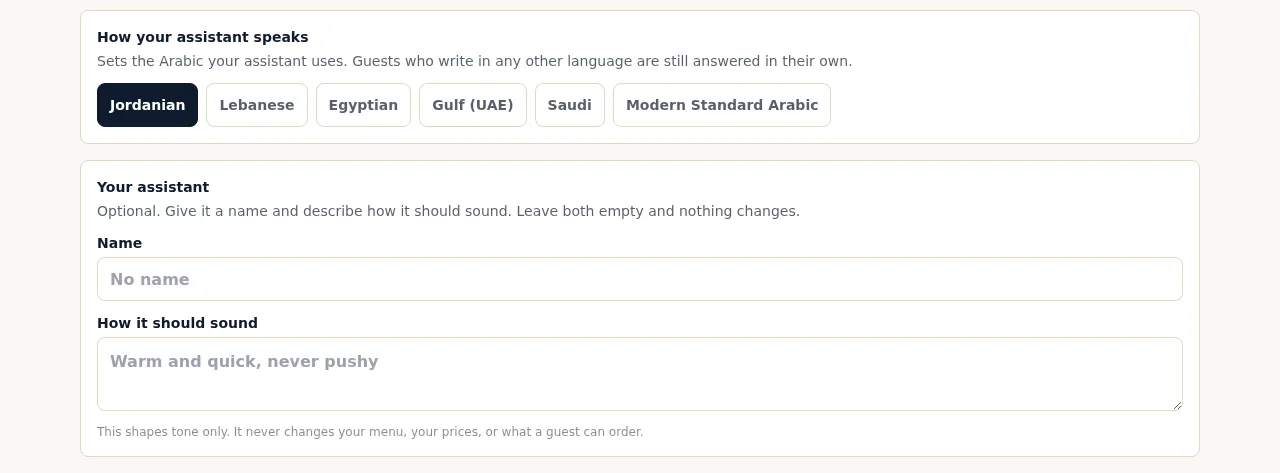
- The Arabic setting. The restaurant's Arabic is set to Jordanian. Owners choose Jordanian, Lebanese, Egyptian, Gulf (UAE), Saudi or Modern Standard Arabic.
- English. "Hi! What fresh juices do you have?"
- Spanish. "Hola, ¿qué jugos naturales tienen? ¿Cuál me recomiendas?"
- Gulf Arabic. "وش عندكم عصيرات طازجة؟ وش تنصحني؟", with the Gulf "وش" (what) rather than the Jordanian "شو", to see which dialect comes back.
- Where. On a phone-sized browser window at one table, on 15 October 2026. Full method.
What happened?
Every question got an answer from the menu, in the guest's language. Dish names stayed as the menu writes them, and the Arabic reply came in the restaurant's Jordanian.
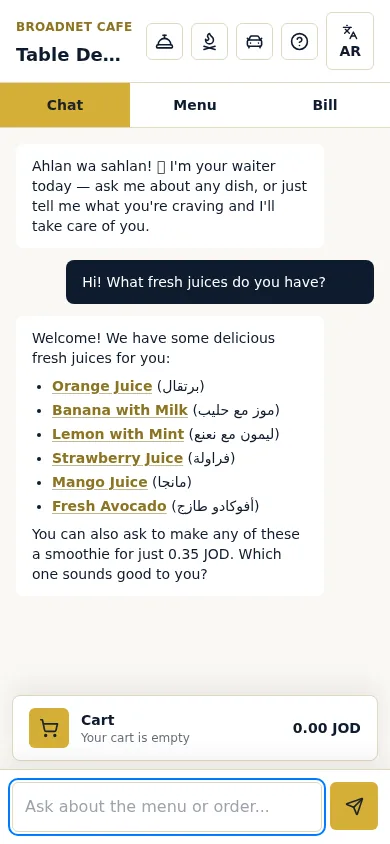
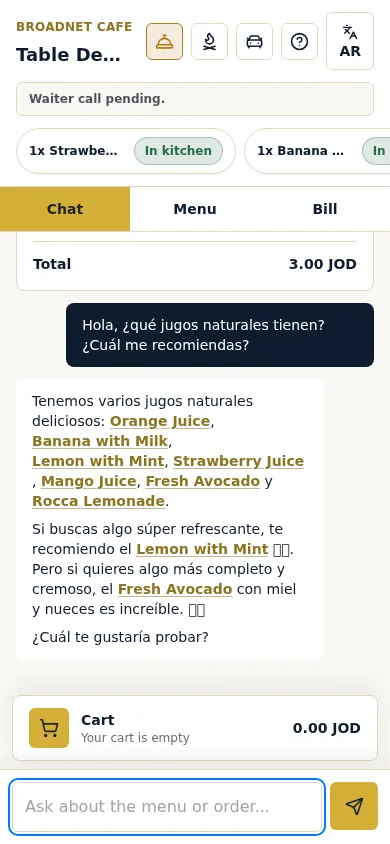
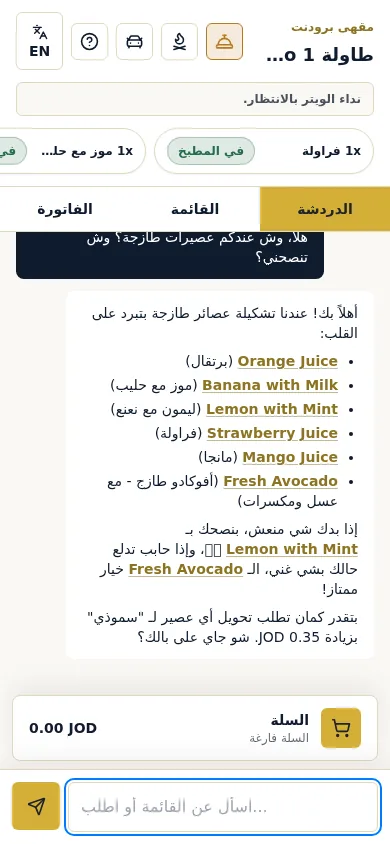
Real screenshots, Broadnet Cafe, 15 October 2026. One run per language; a reply can be worded differently each time.
What does not change with the guest's language?
The conversation follows the guest; the screens and tickets follow your menu. Here is each part, exactly.
| Part | Language | What it means in service |
|---|---|---|
| Chat replies | The language the guest writes in. Tested in English, Arabic and Spanish; most other languages work too | A Spanish speaker gets answers and questions about choices in Spanish |
| Arabic replies | The dialect you choose, whichever dialect the guest writes in | In our test a Gulf question got a Jordanian answer, because that restaurant chose Jordanian |
| Guest screen buttons and tabs | English or Arabic only, switched with the EN/AR button | A Spanish or Japanese speaker sees English buttons; the chat tells them which one to tap |
| Dish names | As written on your menu, with saved Arabic names where you have them | Your kitchen reads the dish names it already knows |
| Notes such as "no onions" | As the request was taken, not translated | A note in Spanish reaches the kitchen in Spanish, so decide who reads it |
| Allergy decisions | Staff, in person | The chat gives what your menu says and asks the guest to confirm with staff, in any language |
Where does the owner set the language?
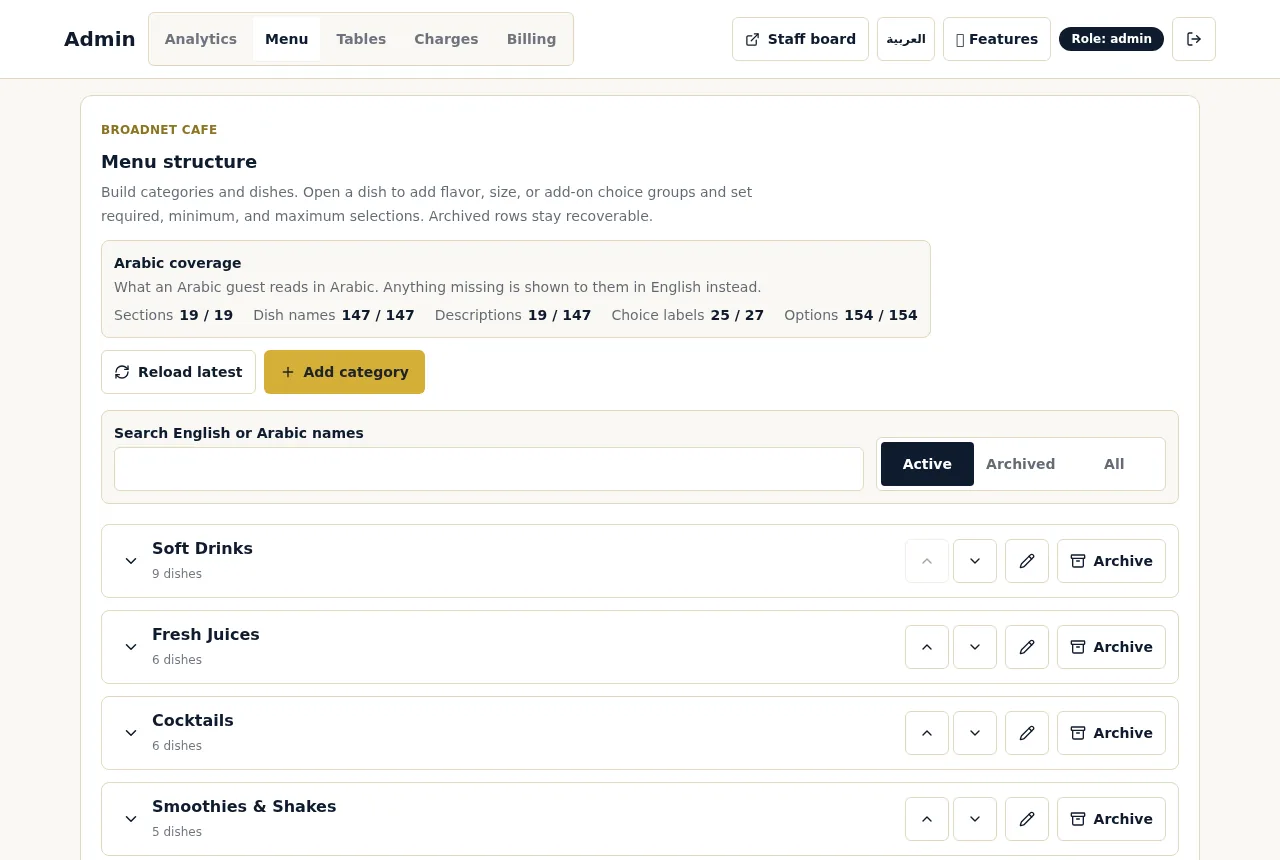
In the owner page. You pick the Arabic your chat speaks and can see how much of your menu an Arabic-speaking guest reads in Arabic.
How can you test it on your own menu?
During your demo or your 30 free days, run the same kind of test with the questions your guests actually ask.
- Pick three or four languages your guests use. Write the same question in each, as a guest would type it on a phone, with the usual mistakes.
- Ask about a dish with choices. Check that the chat asks for the size or side before the order can be confirmed.
- Add a note. "Sin cebolla" or "بدون بصل". Look at the ticket on the staff board: the note arrives as taken, untranslated.
- Ask an allergy question. The chat should give only what your menu says and send the guest to your staff.
- Write Arabic in a different dialect from yours. The reply comes in the dialect you chose. Change the setting and ask again if your guests expect another.
- Check your Arabic coverage. If many guests read Arabic, fill in Arabic descriptions so they don't fall back to English.
- Write down what you saw. Date, language, question, answer, and anything a server had to fix. Repeat after you change the menu.
How should staff handle notes in other languages?
Decide before service who reads them. Notes aren't translated, so a note typed in Japanese reaches the kitchen in Japanese.
- Check notes when you confirm the first order. The first order at each table waits for staff. If a note is in a language nobody on shift reads, a server checks it at the table before confirming.
- Keep a translation app on one staff phone. A phone at the pass with a camera translation app handles most short notes.
- Treat a possible allergy note as a stop. Any note that might be about an allergy gets a person at the table, whatever language it's in. Staff have the final say.
- Know who speaks what. List which staff speak which languages and keep it near the main board, so the right person goes to the table.
Why does ordering in the guest's own language matter?
Because many of your guests read your menu in their second or third language, and not only tourists.
UN Tourism estimates 1.52 billion international tourist arrivals in 2025, almost 60 million more than in 2024 (UN Tourism, January 2026). Locals count too: 22% of people aged 5 and older in the United States spoke a language other than English at home, about 61% of them Spanish (US Census Bureau, June 2025, American Community Survey 2017–2021).
A guest reading a menu in a language they half know picks the dish they recognize, or waits for a server who may not share their language. When they can ask "which juice do you recommend?" in their own words, they get a straight answer from your menu. For a fuller checklist, read how to serve tourists who don't speak your language.
Questions about multilingual ordering
Which languages can guests write in?
Guests chat in their own language. We have tested English, Arabic (several dialects) and Spanish, and it answers most other languages too. If your guests often use another language, test it with us during your demo.
Which Arabic does it speak?
The one you choose: Jordanian, Lebanese, Egyptian, Gulf (Emirati), Saudi or Modern Standard Arabic. In our test a guest wrote in Gulf Arabic and got the restaurant's Jordanian.
Are the buttons translated?
Buttons on the guest screen are in English or Arabic. The chat tells guests in their own language which button to tap.
Are dish names translated?
No. Dish names show as your menu writes them; in our Spanish test the juices kept their English names. Saved Arabic names are shown where you have them.
Are guest notes translated for staff?
No. Notes go on the ticket as the request was taken, not translated. Agree before service who reads notes in other languages.
Can the chat answer allergy questions in other languages?
It gives what your menu says, in the guest's language, and asks the guest to confirm with your staff. Staff have the final word on allergies.
Do I have to translate my menu first?
No. The chat answers from your menu as it is. If many guests read Arabic, Arabic descriptions help, because missing ones show in English.
What should you read next?
- From scan to servedThe whole order flow in real screenshots.
- Our ordering test methodHow we ran these tests, and how to repeat them.
- Waiter call and the billCalls and check requests from the phone.
- Works with your POSOrders on WaiterPilot's screens, sales in your till.
- Pricing$200 per location per month, whatever languages your guests use.